Saturday, 6 July 2013

A Night of Violence as Morsi Supporters Fight for His Return


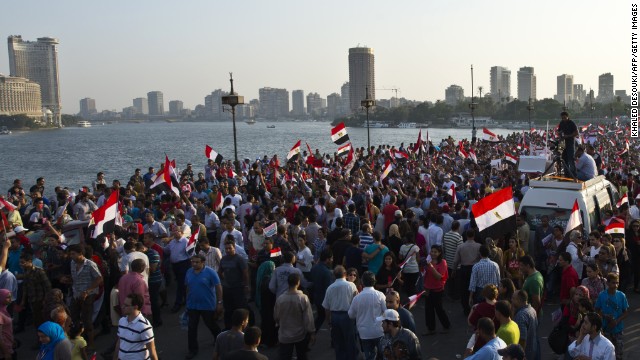
Egyptian officials were assessing the damage Saturday from a night of deadly street fighting as a bitter split over who should be ruling the country led to overnight battles between demonstrators celebrating the ouster of President Mohamed Morsi and crowds of Islamists who wanted him reinstated. 
 
Combatants used rocks, sticks, fireworks and Molotov cocktails in a battle lasting hours that raged Friday night near Tahrir Square and across a bridge spanning the Nile, part of the most widespread street violence in Egypt since the early days of the 2011 revolution.
The mayhem capped a day full of massive and defiant protests by Islamists demanding that Mr. Morsi be returned to power. At least four people were killed and many were wounded when security forces fired into a protest near the officers’ club of the powerful Republican Guard, where many believed Mr. Morsi was detained.
With clashes breaking out late into the night, it was difficult to estimate the full extent of casualties and damage. But early Saturday, the health ministry said at least 30 people were dead and more than a 1,000 people had been injured, many of them in Cairo.
Islamists in other cities across the country also demanded Mr. Morsi’s reinstatement, breaking into government offices in several provinces and temporarily evicting military officials. Fifteen people died in Alexandria, and a curfew was declared in the Sinai Peninsula, where six soldiers and police officers were killed in at least four attacks on security posts.
The wave of violence suggested that the military’s removal of Mr. Morsi, the country’s first freely elected president, after protests by millions of Egyptians angry with his rule, had worsened the deep polarization between Islamists who call his ouster a military coup and their opponents who say his removal was the result of an urgent need to fix Egypt’s myriad problems.
On Saturday, the interim president installed by the military met with the army chief and interior minister, according to media reports. The president, Adli Mansour, a former chief justice of the Supreme Constitutional Court, held talks with Gen. Abdul-Fattah el-Sisi, who is also the defense minister, and with the interior minister, Mohammed Ibrahim, who is in charge of the police, at the presidential palace.
In Washington, the State Department condemned the violence and called for restraint.
“We call on all Egyptian leaders to condemn the use of force and to prevent further violence among their supporters,” said Jen Psaki, a State Department spokeswoman. “As President Obama said, we expect the military to ensure that the rights of all Egyptians are protected, including the right to peaceful assembly, and we call on all who are protesting to do so peacefully.”
By turning out in the tens of thousands, the pro-Morsi crowds underlined the organizational might of the Muslim Brotherhood, which emerged as the major political force and dominated rounds of elections after the country’s revolution two years ago. At that time, it gained power that many in the group had dreamed of for decades. The military’s intervention in politics this week entirely removed it from the government.
The group called the protests the “Friday of Rejection” and chanted for Mr. Morsi’s return.
“We will bring him back bearing him on our necks, sacrifice our souls for him,” Mohamed Badie, the group’s spiritual leader, told an enraged crowd at a large demonstration in the Cairo suburb of Nasr City. “We will bring back the rights of the Egyptian people who were wronged by this disgraceful conspiracy.”
Mr. Badie urged supporters of Mr. Morsi to stay in the streets until he is released by the military and restored to office.
He said the reports that he had been among the Islamist leaders arrested in a post-Morsi crackdown by security forces were false. Hundreds of Islamists were detained within a day after Mr. Morsi’s ouster. Some were released on Friday. 

culled from www.newyorktimes.com

Imo Is Boiling: Okorocha Is A Serial Law Breaker That Has An Incurable Phobia For Due Process - Sen. Hope Uzodinma

Reports monitored in Imo State by Global Reporters Vienna are showing that the state is boiling and if the manipulative and controversial State Assembly election that was held last weekend in Oguta should be the test of future elections in the state, then Imo is in for a shocker that has suggested a bloody 2015 gubernatorial election.

Senator Hope Uzodinma
Immediately after the inconclusive State Assembly election according to INEC held last Saturday in Imo State, Governor Rochas Okorocha held a world conference where he showed purported duly signed results of the elections as it favored his party All Progressives Grand Alliance (APGA) candidate Walter Uzonwanne.  While he urged INEC to declare the results of the elections he alleged had already been concluded, he accused the People’s Democratic Party (PDP) top hierarchy to have made a telephone call to one of the officials of the commission that led to the stoppage of announcing the already signed result sheets.  A telephone call many pro Okorocha have said was from “the Oga at the top”. But contrarily to this claim, Hope Uzodinma, a Senator representing Orlu Senatorial Zone (Imo West) where the elections took place, addressed journalists in Abuja on the same issue and lambasted Okorocha whom he said was not in any place near the election grounds to say the things he had said and called him “ a serial law breaker” that INEC must be very careful about. He went further to say that Okorocha paraded forged results in his world conference and had “no respect for either due process or rule of law”. Also amongst other things he said the rascality of Okorocha’s lieutenants and thugs marred the election.
Below is an excerpt from his address in Abuja.
… “The Okorocha-led government in Imo State is a government that has no respect for either due process or the rule of law. The APGA government in Imo State has shown enough knack for lawlessness to worry all sane minds. I got so worried at a point that I wrote a confidential letter to the governor (which I will now make public), advising him to respect the constitution, he swore to protect and the rule of law which is the lynchpin of democracy. This was in February 2012. Over a year after, I have come to the informed conclusion that Governor Rochas Okorocha has an incurable phobia for law and order. His latest display of unbridled brigandry at the Oguta election is a further proof of this. INEC must therefore constantly watch its back as this man can do anything to torpedo due process.
“Since the bye-election was in my constituency and my party, the Peoples’ Democratic Party (PDP) was contesting in the election, I was personally present at the election. It therefore came to me as a rude shock that the State Governor, Rochas Okorocha, who was nowhere near the election venue, went out of his way to churn out falsehood and raise undue alarm over the said election. I have therefore invited you to set the records straight with a firsthand account of what happened at the election.

Wednesday, 3 July 2013

Nigerian Developer Set to Build Africa's Next Giant City

 Africa's cities are running out of land, prompting a real-estate developer here to erect what might be Africa's ritziest district on a beach long known as a haven for day laborers and beer tipplers.


[SB10001424127887324436104578581582136183450]
Eko Atlantic

The shacks that crowded the shoreline called Bar Beach are gone, replaced by construction tents. Families who squatted here were evicted. For the past four years, a Lebanese-Nigerian property developer has hosed sand into the ocean, creating new land for planned jogging paths, yacht jetties and condominiums with helipads for 250,000 opulent Nigerians.
The new Eko Atlantic township is emblematic of a booming business in Africa in which developers build walled-off cities for the very rich on a continent that is still the world's poorest.
Developer Gilbert Chagoury, founder of Nigeria's Chagoury Group, is the epitome of Africa's moneyed class: Aside from a friendship with Bill Clinton, whose 1996 presidential campaign he helped fund, Mr. Chagoury boasts an ambassadorship from St. Lucia to the Vatican and a gallery in the Louvre named after him and his wife, both contributors.
Flush with funding from French banks that are enticed by Africa's rapid growth, the 67-year-old Mr. Chagoury is aiming to cap his career with the most colossal real-estate project in West Africa.
"This is going to be the equivalent of Champs Élysées in Paris or Fifth Avenue in New York," says David Frame, managing director of South EnergX, a construction unit of Chagoury Group. He was standing on a gravel road that will be paved into an eight-lane boulevard, ending at a gated exit into the rest of Lagos.
Africa has the world's fastest-growing cities, according to the United Nations. Its current urban population of 450 million is expected to triple in the next four decades.
As vacant land vanishes in African cities, foreign investors are responding with the creation of new cities out of forests, grasslands and landfill. Investors expect to wring big profits from offering Africa's wealthy places to live, work and shop away from the crumbling infrastructure and squalor of old cities.
But those projects have come under fire from critics who point out that they will in no way alleviate the housing crisis hitting the majority of the population. In Lagos, few will be able to afford Eko Atlantic's glass tower condos.
Meanwhile, some of these gargantuan projects are struggling. Renaissance Capital Financial Holdings Ltd. of Moscow plans to build a city for 62,000 people on a coffee farm outside Nairobi, Kenya, and a similar-size project on a pepper field near Ghana's capital of Accra.
The coffee farm in Kenya is still just that, as Renaissance works out a dispute with shareholders. The project in Ghana is mired in a disagreement between local chiefs over who owns the pepper field.
China International Trust and Investment Corp. built a $3.5 billion city for 500,000 people near Angola's capital, Luanda. The suburb opened in 2011 but remains a ghost town, as the government strains to sell the $200,000 condos to a population whose per-capita income is $6,000 a year.
Mr. Chagoury hopes that Eko Atlantic will be different. Project executives point to Lagos's population of oil-rich elites, which is both larger than that of Luanda's and readier to pay top dollar for clean streets and modern infrastructure. They decline to say how much Eko Atlantic will cost, other to say it will be "in the billions" of dollars.
What the Eko Atlantic construction site looks like today
Their city, Lagos, is crowded and chaotic. Its population grows by nine people every 10 minutes, according to the U.N., which estimates that Lagos has 11 million people and is the world's fastest-growing megacity. The Nigerian government puts the city's total population at 21 million.
Even in posh neighborhoods, sewage bubbles up from open ditches. For want of office towers, hundreds of companies squeeze their headquarters into moldy midcentury ranch houses. At lunch, many companies turn off their lights to rest chugging electric generators. To escape choking traffic, many elites commute by helicopter or yacht.

65.5 per cent of girls in the North-east region of Nigeria lack access to basic education


A non-governmental organisation (NGO) known as the Nigeria Northern Education Initiative (NEI) funded by the United States Agency for International Development (USAID) has disclosed that about 65.5 per cent of girls in the North-east region of Nigeria lack access to basic education.
This was disclosed by an education expert, Hajiya Bintu Abba Ibrahim, during a public presentation of gender assessment findings on basic education and living conditions of orphans and vulnerable children organised by Bauchi State Ministry of Women Affairs and Child Development in collaboration with NEI in Bauchi yesterday.
Ibrahim explained that the percentage of boys in primary school in the region was 49 per cent while that of the girls was 37.1.
The  education expert, who disclosed that Nigeria had 17.5 million orphan and vulnerable children, advocated for their basic rights such as access to education, fundamental human rights for boys and girls and improved standard of living.

65.5 per cent of girls in the North-east region of Nigeria lack access to basic education


A non-governmental organisation (NGO) known as the Nigeria Northern Education Initiative (NEI) funded by the United States Agency for International Development (USAID) has disclosed that about 65.5 per cent of girls in the North-east region of Nigeria lack access to basic education.
This was disclosed by an education expert, Hajiya Bintu Abba Ibrahim, during a public presentation of gender assessment findings on basic education and living conditions of orphans and vulnerable children organised by Bauchi State Ministry of Women Affairs and Child Development in collaboration with NEI in Bauchi yesterday.
Ibrahim explained that the percentage of boys in primary school in the region was 49 per cent while that of the girls was 37.1.
The  education expert, who disclosed that Nigeria had 17.5 million orphan and vulnerable children, advocated for their basic rights such as access to education, fundamental human rights for boys and girls and improved standard of living.

65.5 per cent of girls in the North-east region of Nigeria lack access to basic education


A non-governmental organisation (NGO) known as the Nigeria Northern Education Initiative (NEI) funded by the United States Agency for International Development (USAID) has disclosed that about 65.5 per cent of girls in the North-east region of Nigeria lack access to basic education.
This was disclosed by an education expert, Hajiya Bintu Abba Ibrahim, during a public presentation of gender assessment findings on basic education and living conditions of orphans and vulnerable children organised by Bauchi State Ministry of Women Affairs and Child Development in collaboration with NEI in Bauchi yesterday.
Ibrahim explained that the percentage of boys in primary school in the region was 49 per cent while that of the girls was 37.1.
The  education expert, who disclosed that Nigeria had 17.5 million orphan and vulnerable children, advocated for their basic rights such as access to education, fundamental human rights for boys and girls and improved standard of living.

Monday, 1 July 2013

Egyptian military issues warning over protests


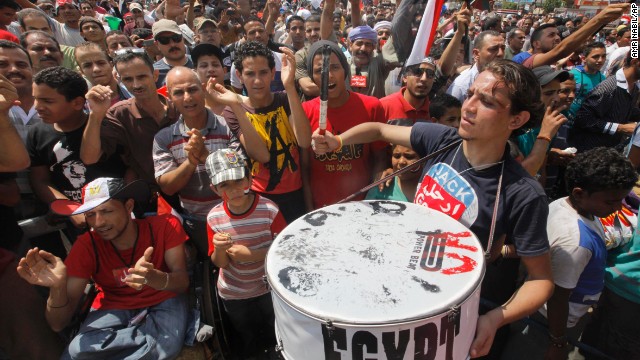
Egyptian protesters shout slogans and wave national flags during a demonstration against President President Mohamed Morsy in Tahrir Square in Cairo on Monday, July 1. Pro- and anti-government protests have spread around the country surrounding the one-year mark of Morsy coming into office on Sunday, June 30. 

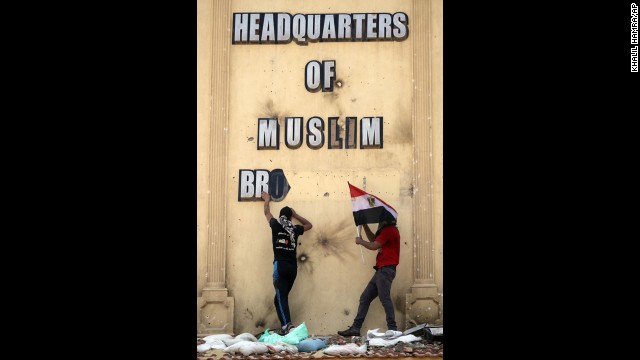
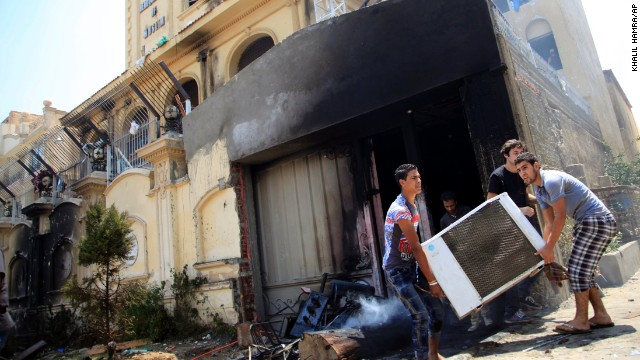
Egyptian protesters ransack the Muslim Brotherhood headquarters in the Muqatam district in Cairo on July 1. Protesters stormed and ransacked the headquarters of Morsy's Muslim Brotherhood group early Monday. 
Egyptian protesters ransack the Muslim Brotherhood headquarters in Cairo on July 1. 
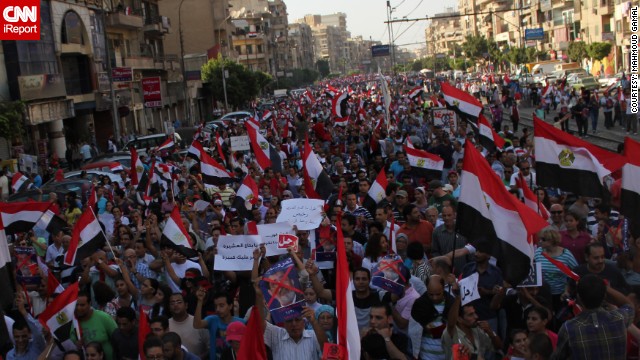
<a href='http://ireport.cnn.com/docs/DOC-997711'>iReporter Mahmoud Gamal </a>attended Sunday's protests in Cairo against President Mohamed Morsy and his government. His photos capture the vibrancy of the protests -- from a dog wearing an anti-Morsy shirt to protesters waving red cards like referees in a football game, calling on Morsy to resign.  

Thousands of opponents of Egyptian President Mohamed Morsy pray during a protest<a href='http://cnn.com/2013/07/01/world/meast/egypt-protests/index.html'> calling for his ouster </a>at Cairo's landmark Tahrir Square on June 30. On the first anniversary of his inauguration, Morsy's Islamist supporters vow to defend his legitimacy to the end.  

Opponents of Morsy march on the Qasr el-Nil bridge leading to Tahrir Square.


Egypt's armed forces sent a stiff message to the country's embattled president and his political opponents and allies, saying Monday that the growing governing dispute must be resolved in 48 hours or it will step in to restore order.
"The armed forces repeat their call for the people's demand to be met and gives everyone 48 hours as a final chance to shoulder the burden of a historic moment in our country which will not forgive any party that will be negligent in bearing their responsibility," it said.
The statement clearly energized a crowd of protesters in Cairo's Tahrir Square, who cheered during key points and cheered military helicopters flying overhead. Some of the helicopters carried Egyptian flags.
Egyptian protesters want Morsy out
Crowds reach leader's palace in Egypt
A source close to highly placed members of Egypt's leadership said that the military's statement was essentially a demand for political restructuring, including early presidential and parliamentary elections.
The statement is a warning that the military will take over the government if President Mohamed Morsy does not accede to the demands, the source said.
The military's announcement comes the same day the protest movement announced on Facebook that if Morsy doesn't leave office by Tuesday, the Tamarod (the "rebel" campaign") group will begin a civil disobedience movement, call for nationwide protests and march on the presidential palace, where Morsy's administration is running affairs.
On Monday, protesters stormed the main headquarters of the Muslim Brotherhood, the party that Morsy led before his election. Armed with Molotov cocktails, the mob set the office on fire, shouting, "The people have toppled the regime."
At least 16 people were killed and more than 780 were wounded Sunday and Monday during the unrest in Egypt, the nation's health minister said, according to the official Egypt News agency.
Dr. Mohammed Mustafa Hamid told the news agency that eight people alone were killed in clashes at the Muslim Brotherhood's national headquarters in Cairo. All but 182 of the wounded have left the hospital after receiving treatment for their injuries.
State-funded Egyptian daily Al-Ahram also reported 46 sexual assaults during anti-Morsy protests in Egypt since Sunday, citing volunteer group Operation Anti-Sexual Harassment.