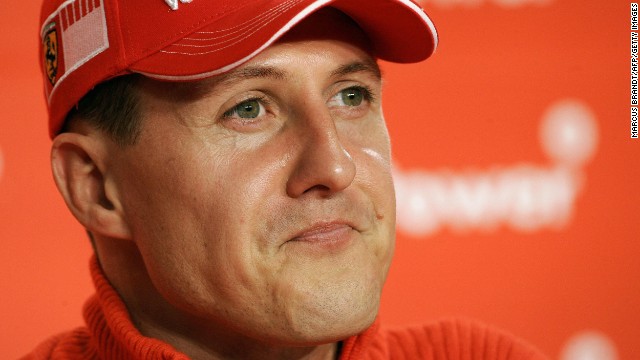
Seven-time Formula 1 champion Michael Schumacher gives a news conference in Sao Paulo, Brazil, in 2011. The German driver was hospitalized December 29 after suffering "severe head trauma" from a ski accident in the French Alps. Here's a look back at his personal and career highlights:
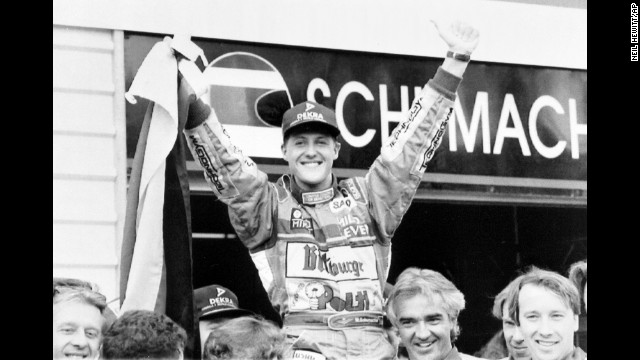
Schumacher is hoisted by his pit crew at the Australian Grand Prix track in Adelaide, Australia, after winning the Formula 1 World Drivers Championship in 1994.
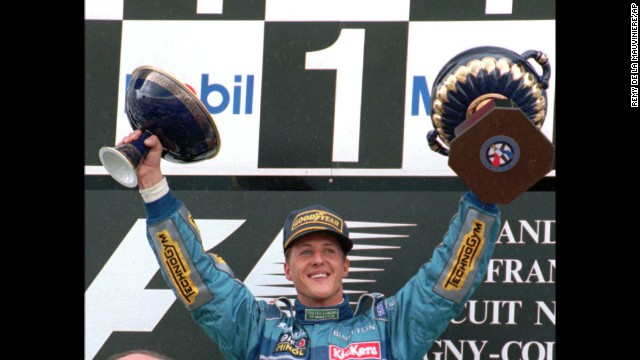 Schumacher holds up
the victory trophy, left, and the French Republic President's trophy
after winning the French Formula 1 Grand Prix in Magny Cours, France, in
1995.
Schumacher holds up
the victory trophy, left, and the French Republic President's trophy
after winning the French Formula 1 Grand Prix in Magny Cours, France, in
1995."There are those who keep out of mischief, and then there are the adventurers," Juan Manuel Fangio, the pioneering legend of Formula One racing, said in the 1990s.
"We racing drivers are adventurers; the more difficult something is, the greater the attraction that comes from it.
"Michael Schumacher is the greatest of the adventurers."
He's not just been an
adventurer. He is a man whose image transcends sport, much like Roger
Federer, Sachin Tendulkar, Martina Navratilova, Tiger Woods, Pele and
Usain Bolt.
The adventurer Schumacher, who suffered a serious head injury in a skiing accident Sunday, is a man for whom winning became an obsession.
He racked up victories,
wins and titles -- and then some: five consecutive world championship
titles between 2001-2004, 56 race victories in six years between
2000-2006, a total of seven F1 crowns and 91 grand prix wins.
Race car driver fights for his life
Michael Schumacher's condition unchanged
What happened in Schumacher accident?
After claiming his first
two titles at Benetton in 1994 and 1995, Schumacher moved to Ferrari
where he would go on to bring about a period of domination.
His 72 race victories and
five world titles with the "Scuderia" etched his name into F1 folklore
and made him the most successful driver in the history of the sport.
His search for perfection translated to recreational activities such as skiing.
"Schumacher wasn't a
skier when he joined Ferrari, but by the end he was excellent," British
journalist Kevin Garside told CNN. "Each year Ferrari used to have a
media week in the Alps in Italy and they would always have a race -- and
it was always Schumacher who won."
Few doubted Schumacher's natural talent, but his desire to win at all costs didn't always endear him to the watching world.
Ayrton Senna, the triple
world champion who was killed at the 1994 San Marino Grand Prix,
remains revered to this very day, while 1950s hero Fangio -- a five-time
F1 champion -- was also hugely popular.